
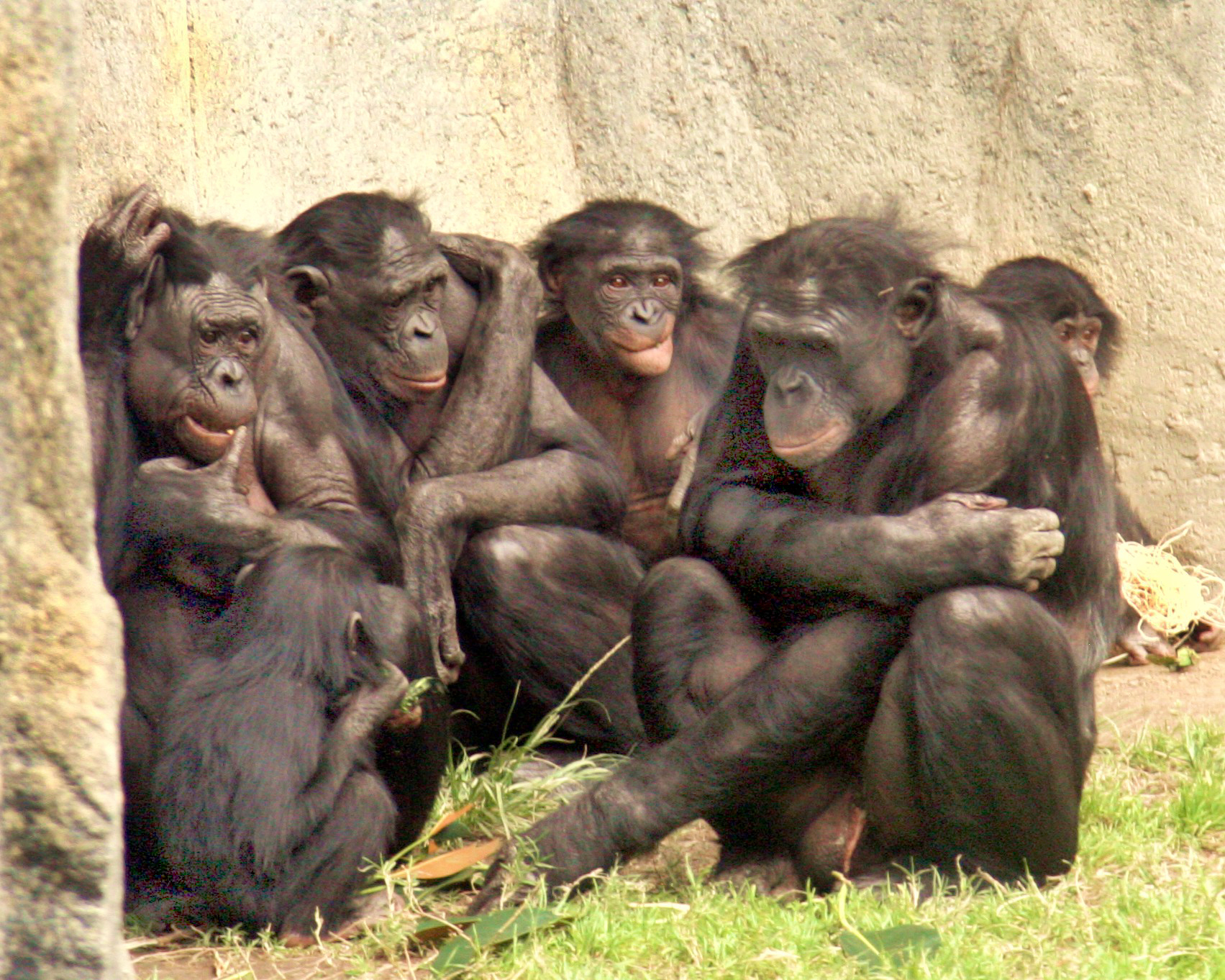
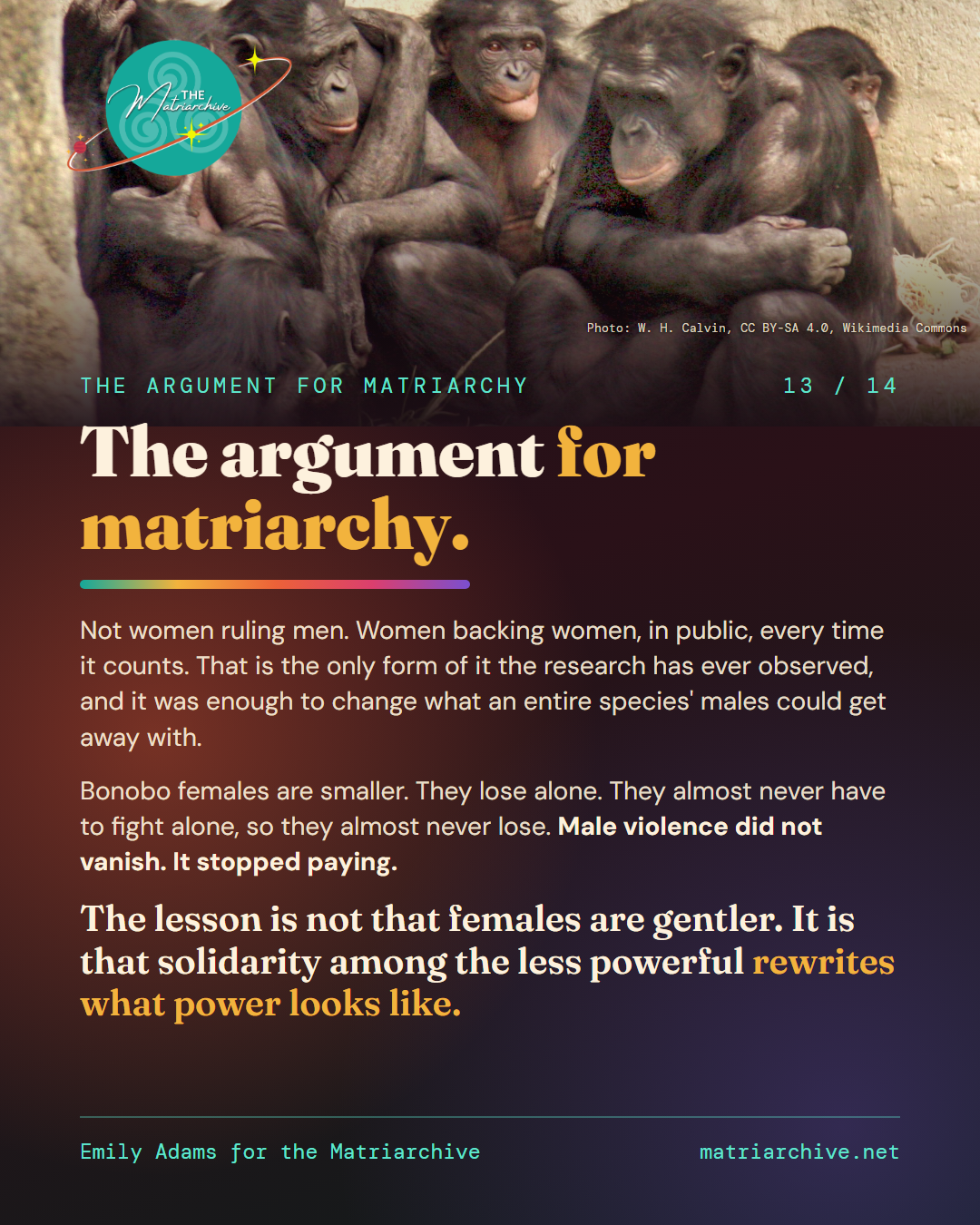
 Photo: W. H. Calvin, CC BY-SA 4.0, Wikimedia Commons
Mother dispatch · A card series
The Argument for Matriarchy
Bonobos and chimpanzees are equally close to us. One of them kills. The other has females who hold power together. Fourteen cards, twenty-plus studies, and the honest version of what female coalitions did to male violence.
The receipts
- 152 : 1Killings recorded across 18 chimpanzee communities studied (in 15 of them) against one suspected killing across four bonobo communities, in five decades of field records.
- 61%Of conflicts between the sexes, across six wild bonobo communities and thirty years, in which the male backed down. Eighty-five percent of female coalitions targeted a male.
- 2.8xHow much more often wild male bonobos got into aggressive interactions than wild male chimpanzees. Nobody eradicated anything. The dangerous kind stopped paying.
- 3xA male bonobo's odds of fathering offspring when his mother lived in the group. In chimpanzees, a mother made no difference.
How female bonobos changed what their males could get away with
Bonobos and chimpanzees are equally close to us, and they could not live more differently. Chimpanzee males patrol, raid, and kill. Across eighteen chimpanzee communities studied, researchers recorded 152 killings, in fifteen of them. Across four bonobo communities, one suspected killing. The difference is not the males. It is who holds power, and how.
Female bonobos are smaller than males, and alone they would lose most fights. So they do not fight alone. When a male harasses a female, other females come in as a group and drive him off. Those coalitions form between females who are mostly unrelated and who arrived in the community as strangers, bonded through years of grooming and close contact. A male who attacks a female risks a coordinated response he cannot win.
That did not make male bonobos gentle. A 2024 study of wild males found that bonobo males get into more aggressive interactions than chimpanzee males do. What collapsed was the kind of aggression that kills: coalitionary attacks, injuries, and males attacking females. Nobody eradicated anything. Female coalitions made the worst kind of male aggression a losing move, and over generations that math changed which males thrived. The ones who do best are not the biggest or the most aggressive. They are the sons of well-connected mothers, who stay near their mothers for life and inherit their standing. In chimpanzees, mothers make no such difference.
The result is a society that primatologists describe as female-dominant or co-dominant, where old females lead the group's movements, where disputes end in reconciliation more often than force, and where strangers from the next community get groomed and fed instead of attacked. The lesson is not that females are gentler. It is that solidarity among the less powerful can rewrite what power looks like.
A note on the word
Researchers do not call bonobos a matriarchy. The field terms are female-dominant and co-dominant, and the 2025 six-community study shows that female power varies a great deal by community and year. The series uses the word on purpose, defines it on card 2 as power held by females through coalition rather than by force, and prints the researchers' own terms in the scope line. Nothing on a research card is a claim about human women or men. The human application lives on the two closing cards, in the first person, and in one clearly labeled human study.
The cards
Fourteen cards and a closer
Every research card carries the finding, three lines to say out loud, a scope line in gold, the citation, and a QR to the study below. Tap a card to open it full size. Every photograph is a real bonobo, credited at the bottom of this page.
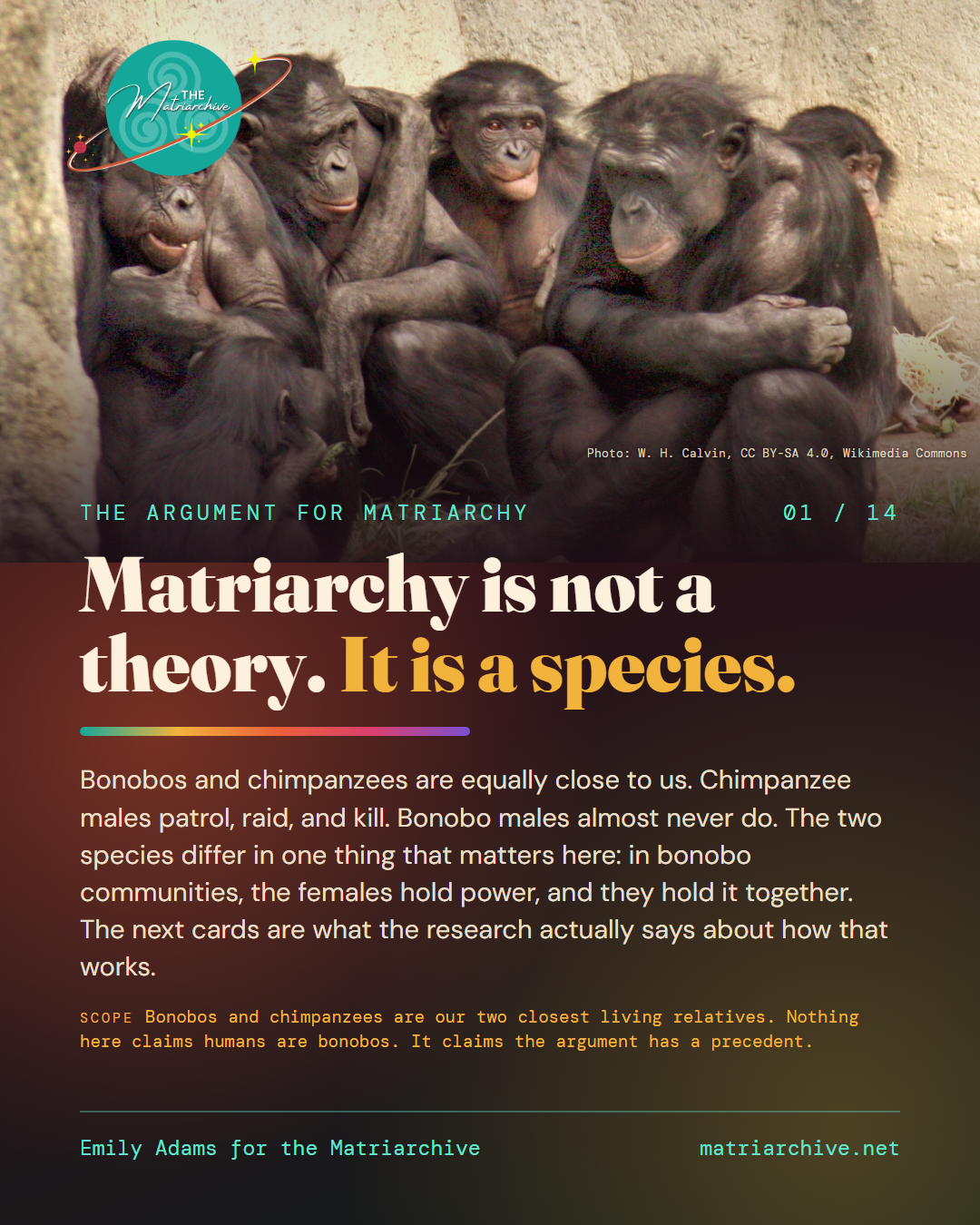
Bonobos and chimpanzees are our two closest living relatives. Nothing here claims humans are bonobos. It claims the argument has a precedent.
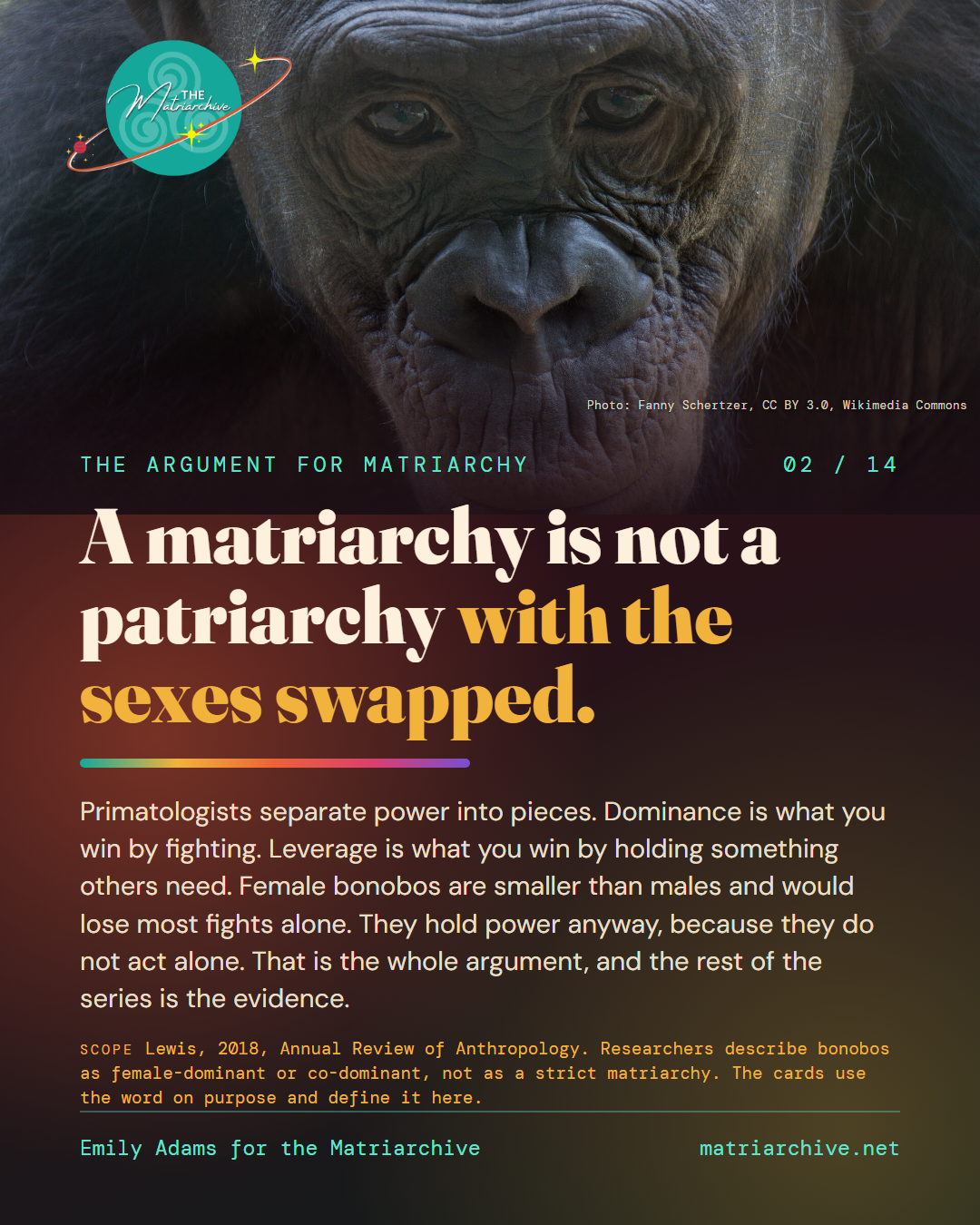
Lewis, 2018, Annual Review of Anthropology. Researchers describe bonobos as female-dominant or co-dominant, not as a strict matriarchy. The cards use the word on purpose and define it here.
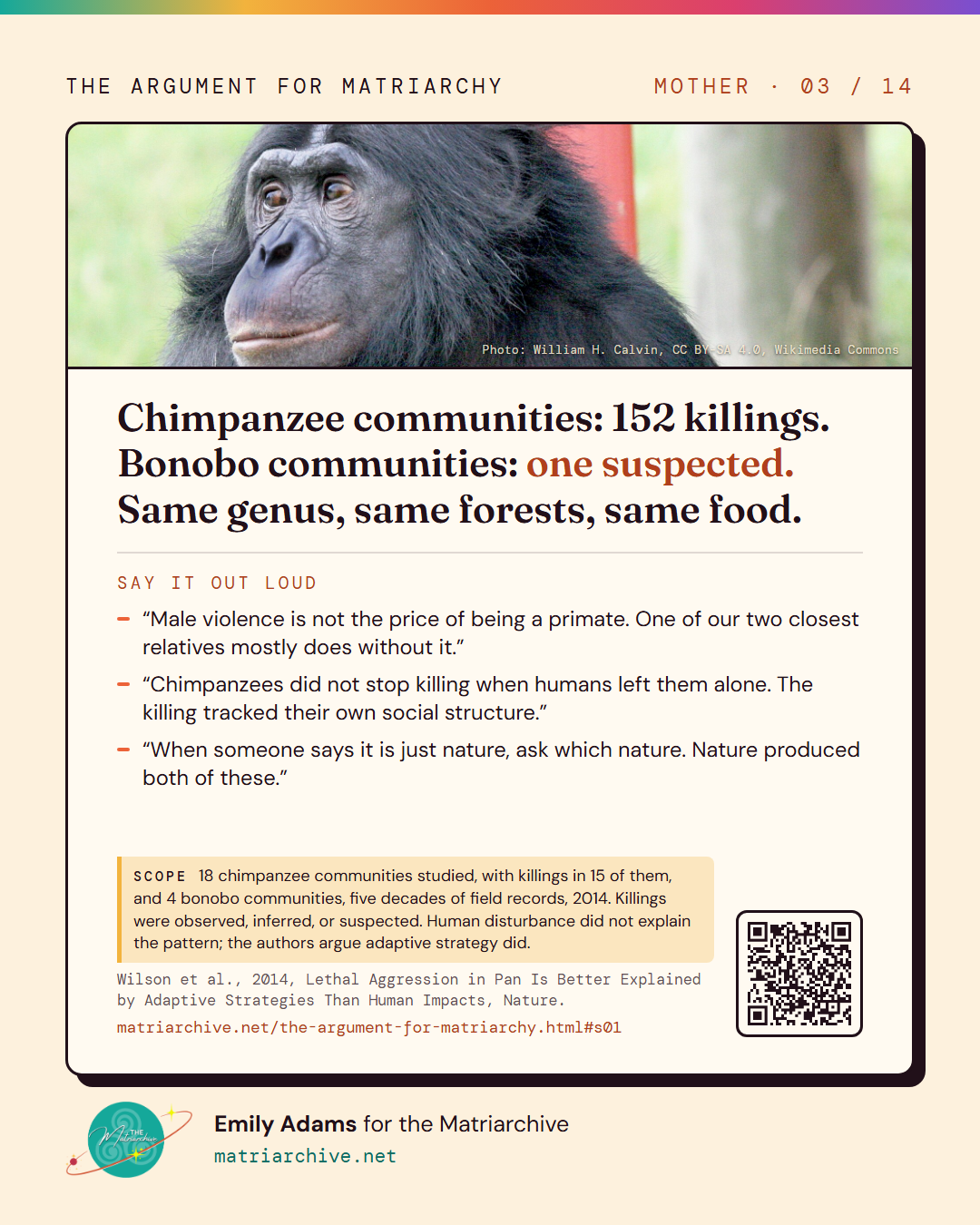
18 chimpanzee communities studied, with killings in 15 of them, and 4 bonobo communities, five decades of field records, 2014. Killings were observed, inferred, or suspected. Human disturbance did not explain the pattern; the authors argue adaptive strategy did.
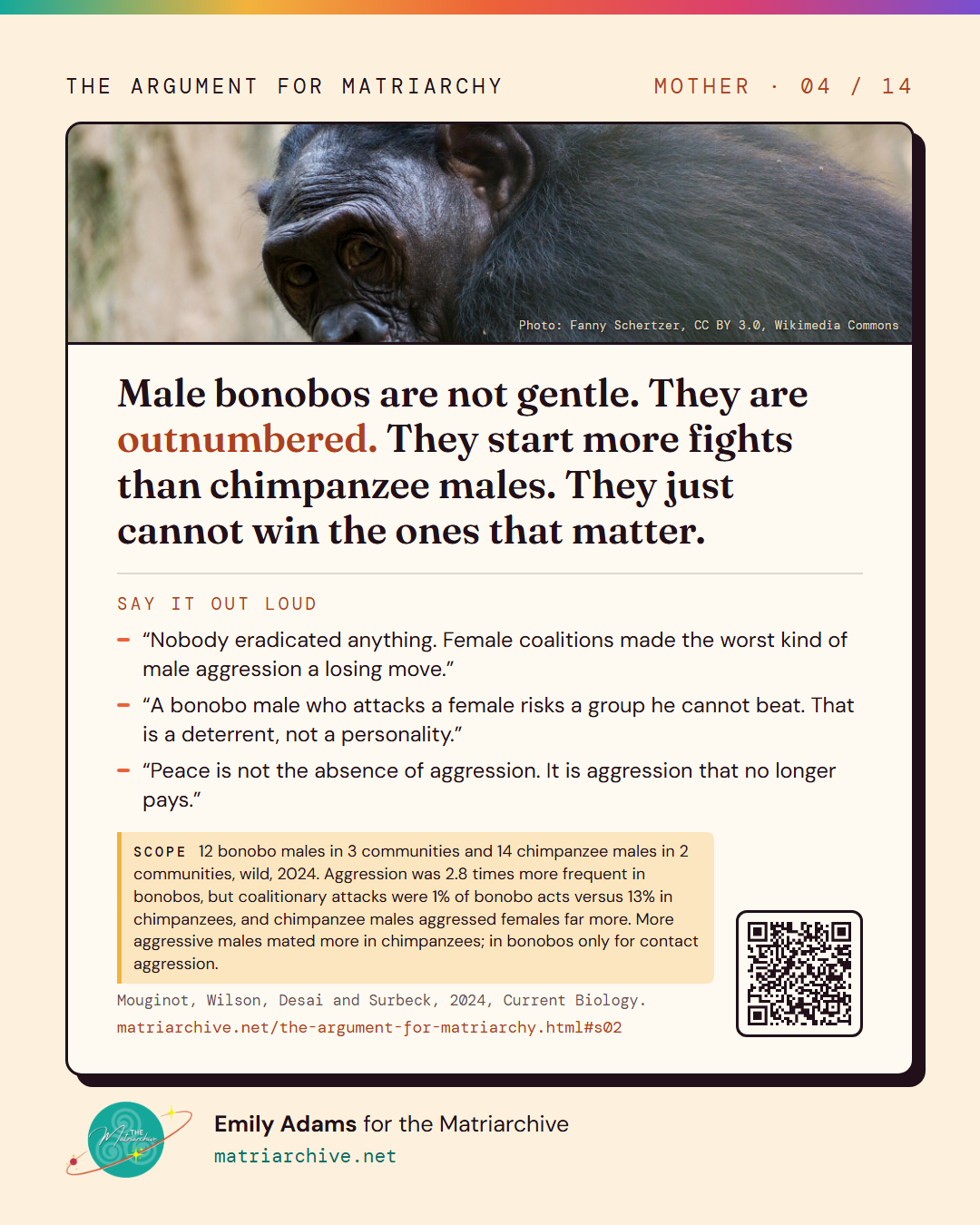
12 bonobo males in 3 communities and 14 chimpanzee males in 2 communities, wild, 2024. Aggression was 2.8 times more frequent in bonobos, but coalitionary attacks were 1% of bonobo acts versus 13% in chimpanzees, and chimpanzee males aggressed females far more. More aggressive males mated more in chimpanzees; in bonobos only for contact aggression.
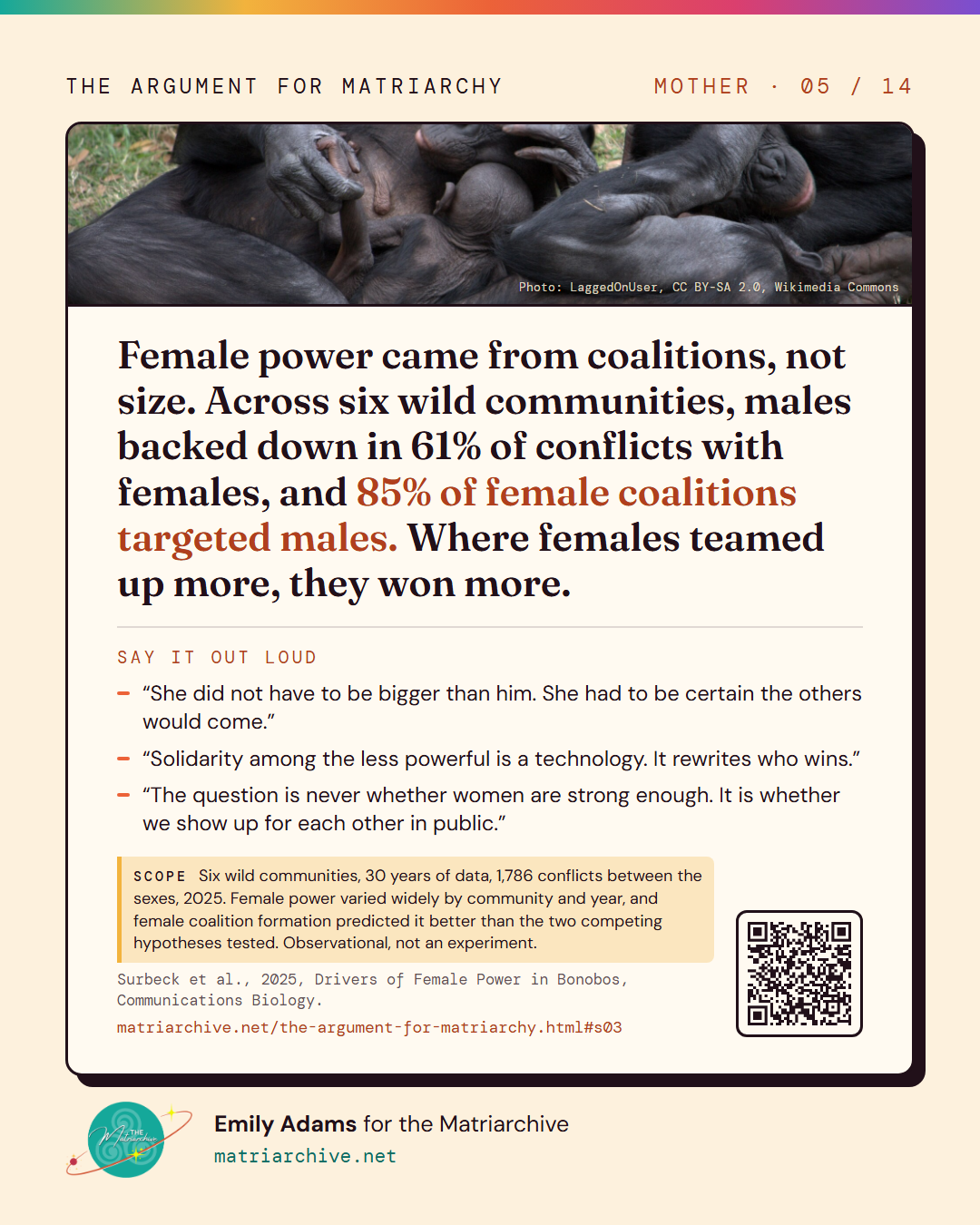
Six wild communities, 30 years of data, 1,786 conflicts between the sexes, 2025. Female power varied widely by community and year, and female coalition formation predicted it better than the two competing hypotheses tested. Observational, not an experiment.
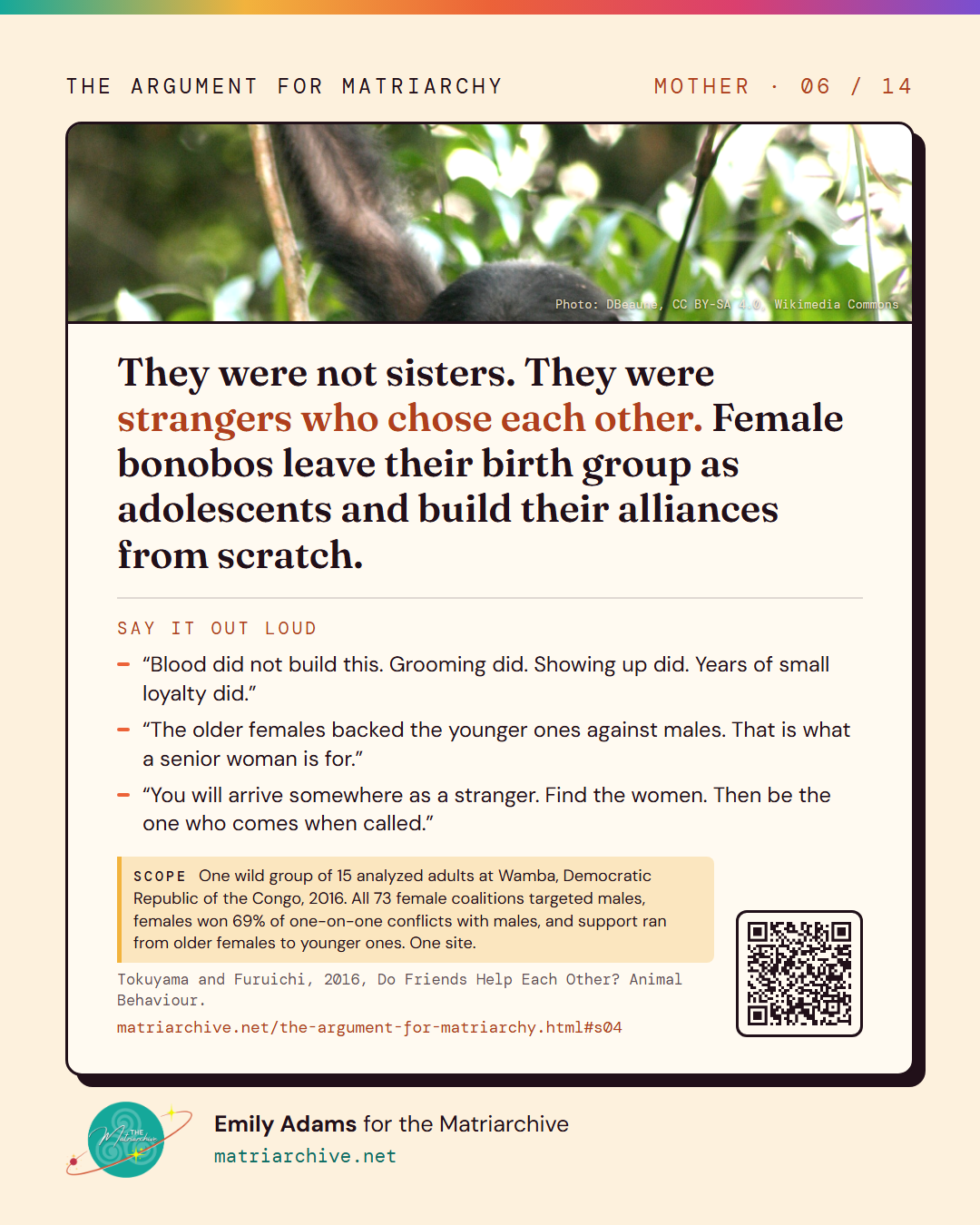
One wild group of 15 analyzed adults at Wamba, Democratic Republic of the Congo, 2016. All 73 female coalitions targeted males, females won 69% of one-on-one conflicts with males, and support ran from older females to younger ones. One site.
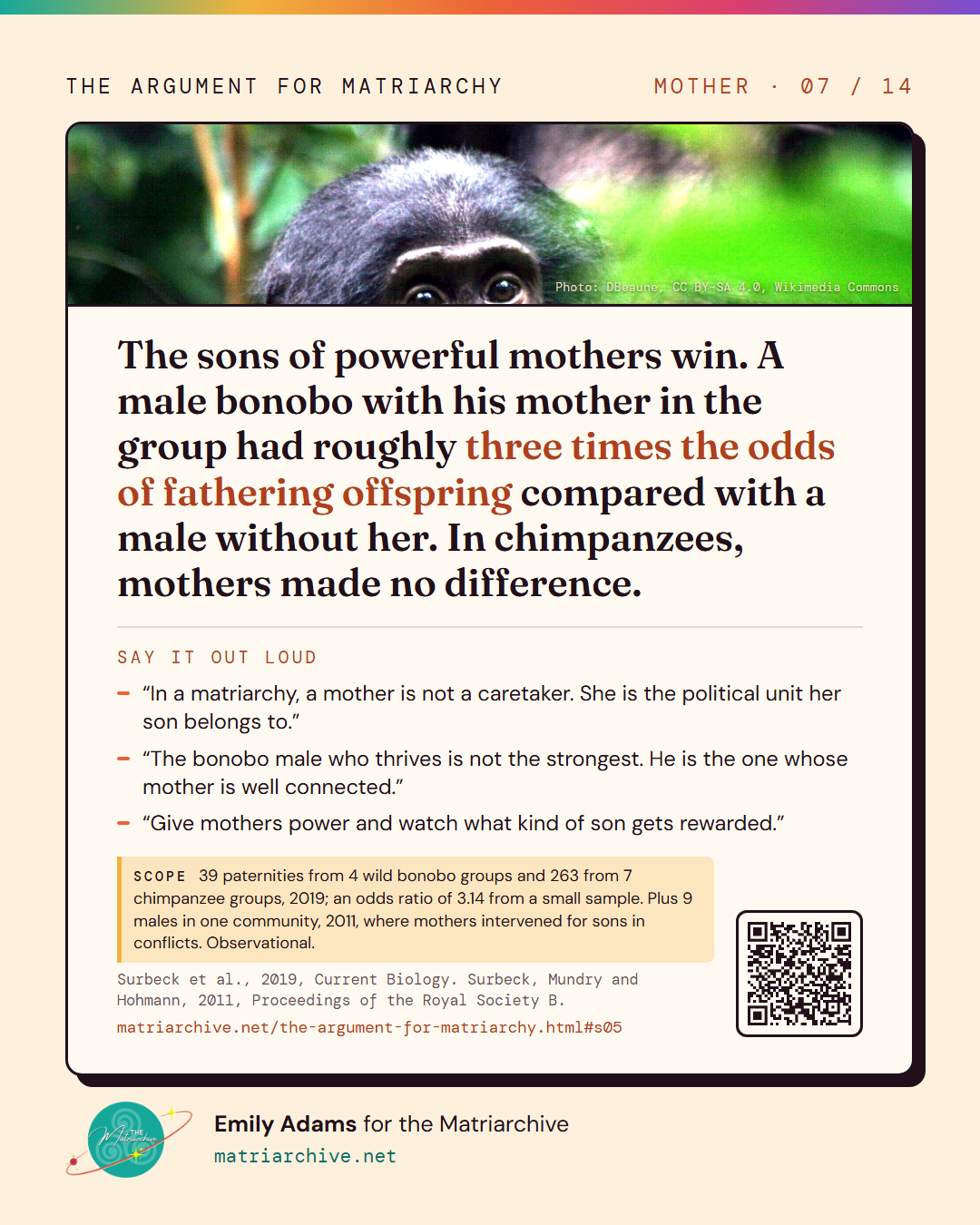
39 paternities from 4 wild bonobo groups and 263 from 7 chimpanzee groups, 2019; an odds ratio of 3.14 from a small sample. Plus 9 males in one community, 2011, where mothers intervened for sons in conflicts. Observational.
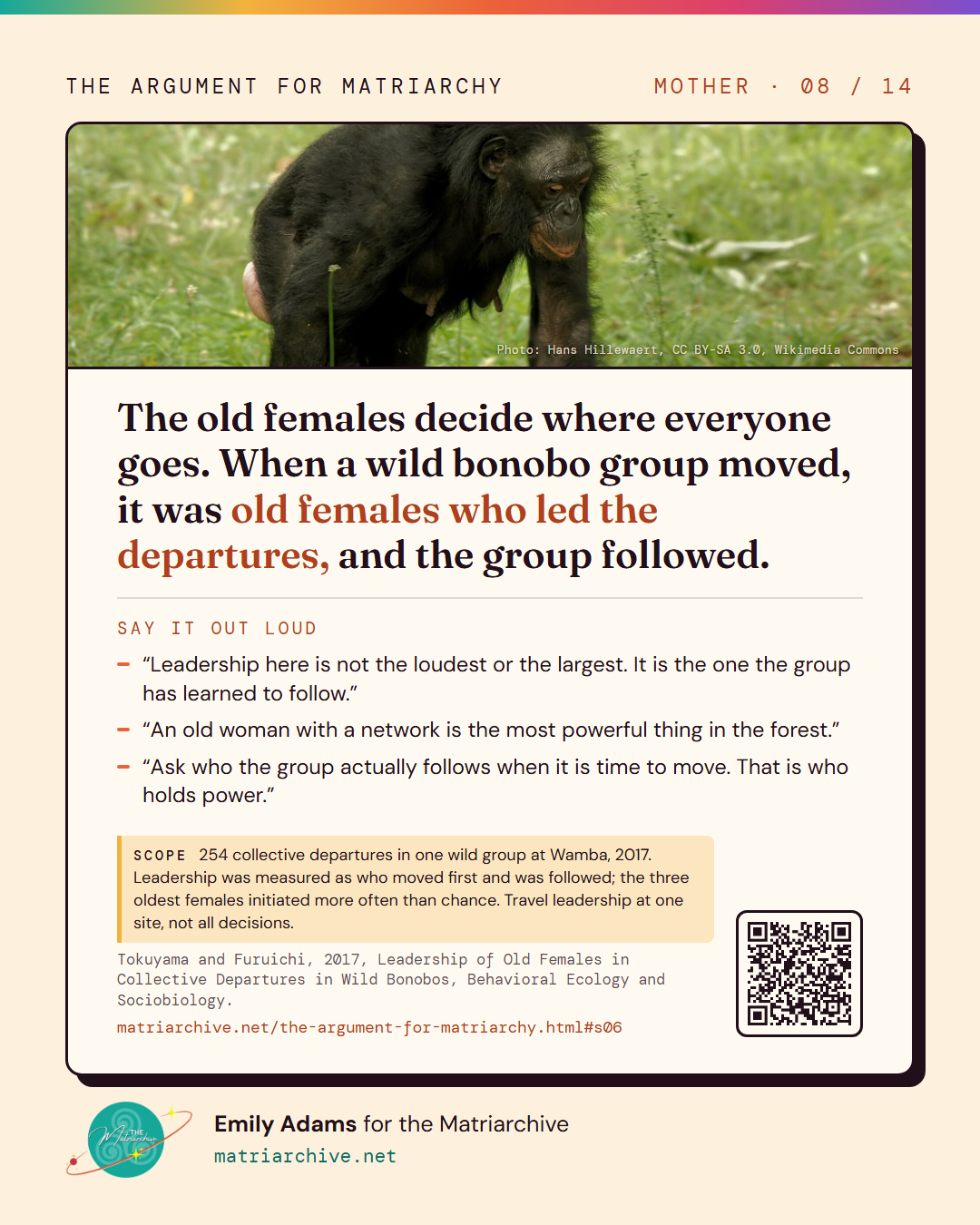
254 collective departures in one wild group at Wamba, 2017. Leadership was measured as who moved first and was followed; the three oldest females initiated more often than chance. Travel leadership at one site, not all decisions.
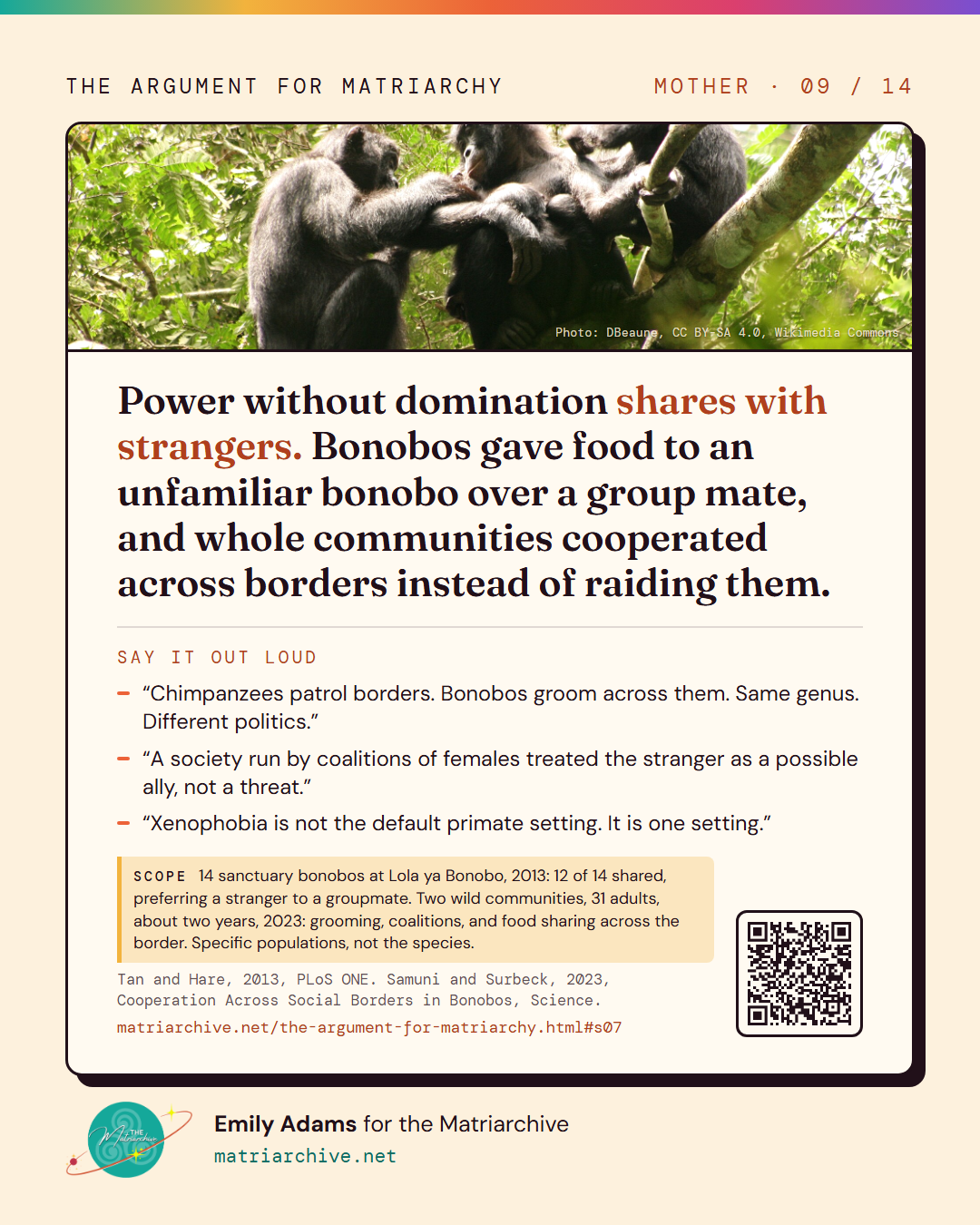
14 sanctuary bonobos at Lola ya Bonobo, 2013: 12 of 14 shared, preferring a stranger to a groupmate. Two wild communities, 31 adults, about two years, 2023: grooming, coalitions, and food sharing across the border. Specific populations, not the species.
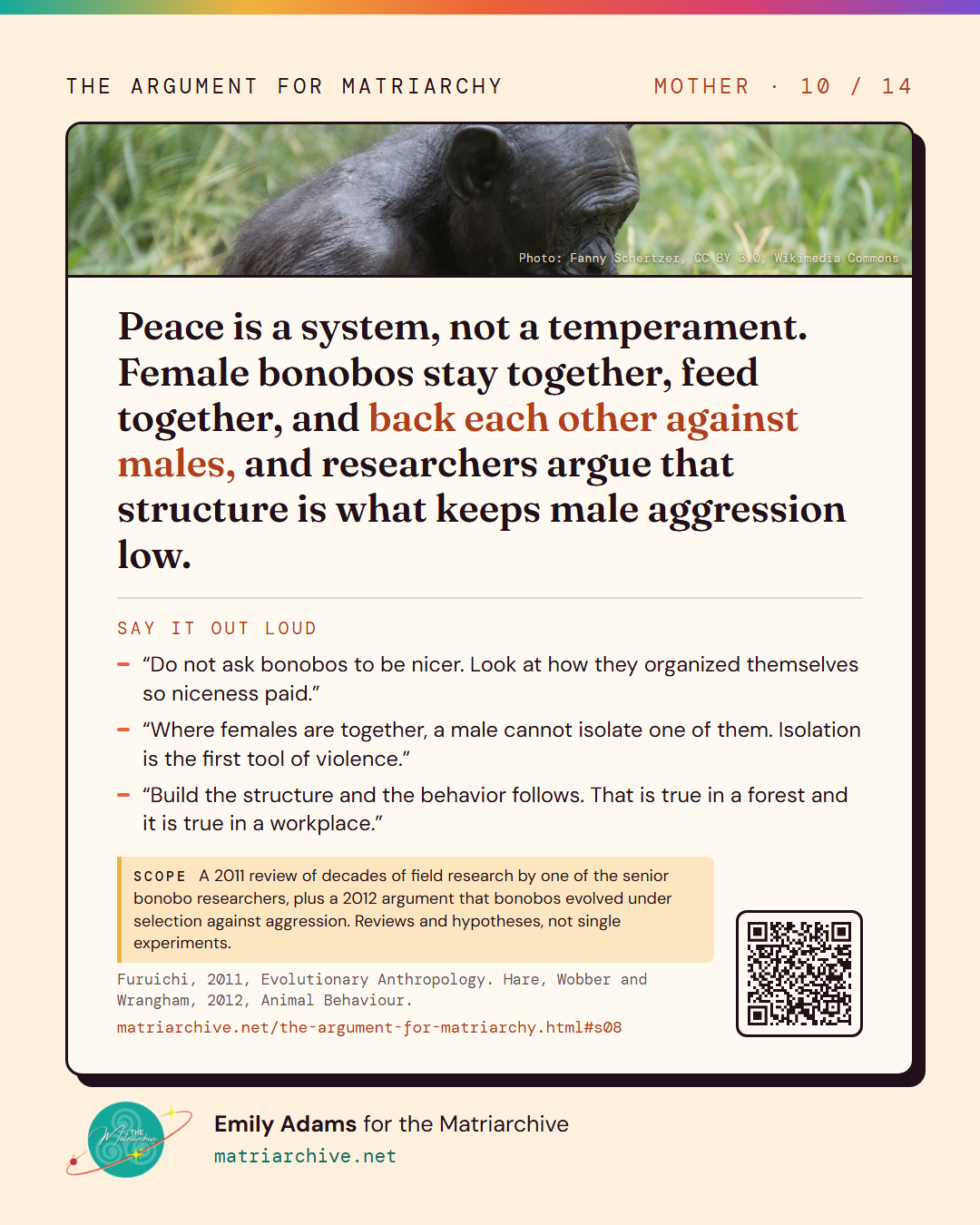
A 2011 review of decades of field research by one of the senior bonobo researchers, plus a 2012 argument that bonobos evolved under selection against aggression. Reviews and hypotheses, not single experiments.
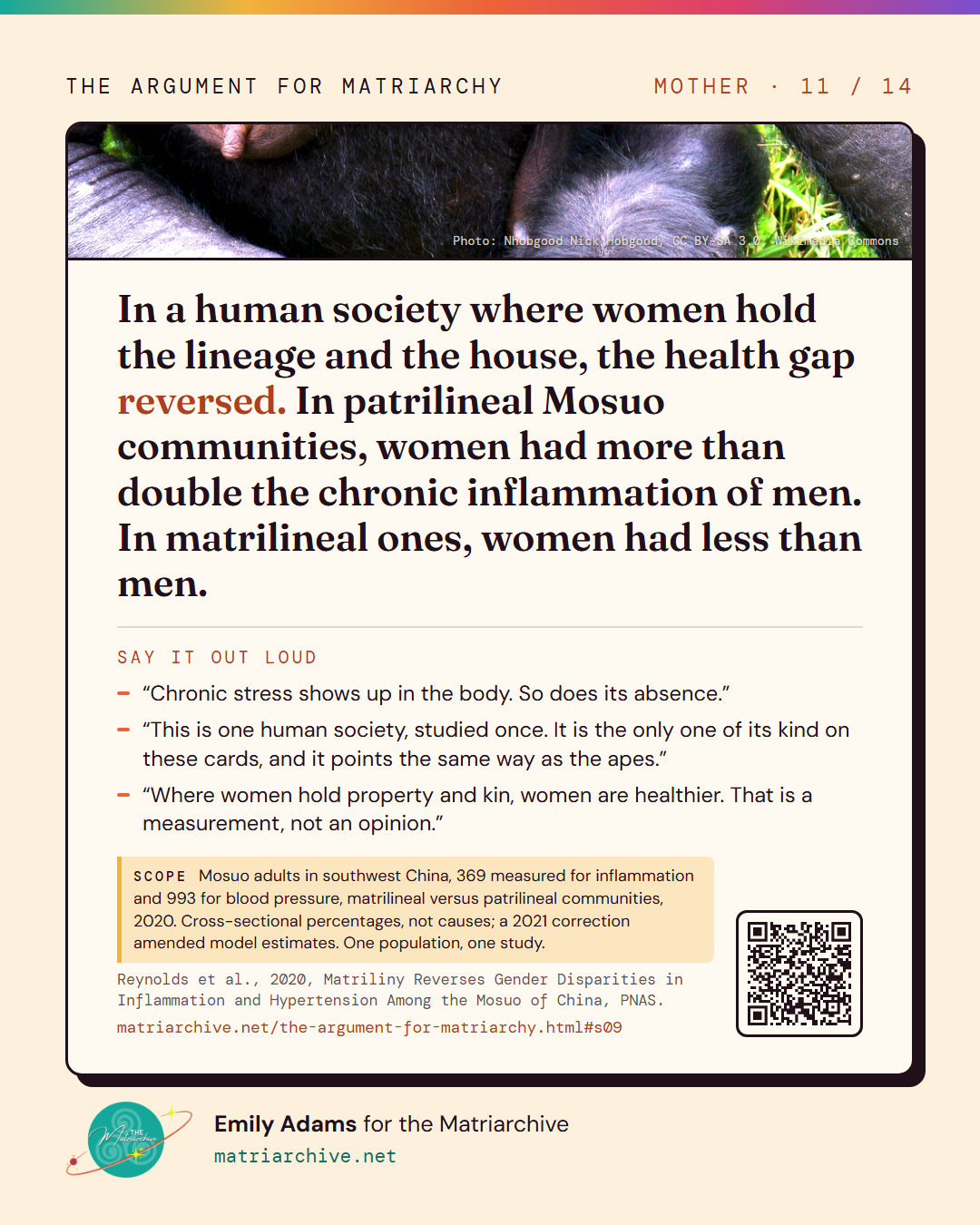
Mosuo adults in southwest China, 369 measured for inflammation and 993 for blood pressure, matrilineal versus patrilineal communities, 2020. Cross-sectional percentages, not causes; a 2021 correction amended model estimates. One population, one study.

Say it out loud
The lines, in full
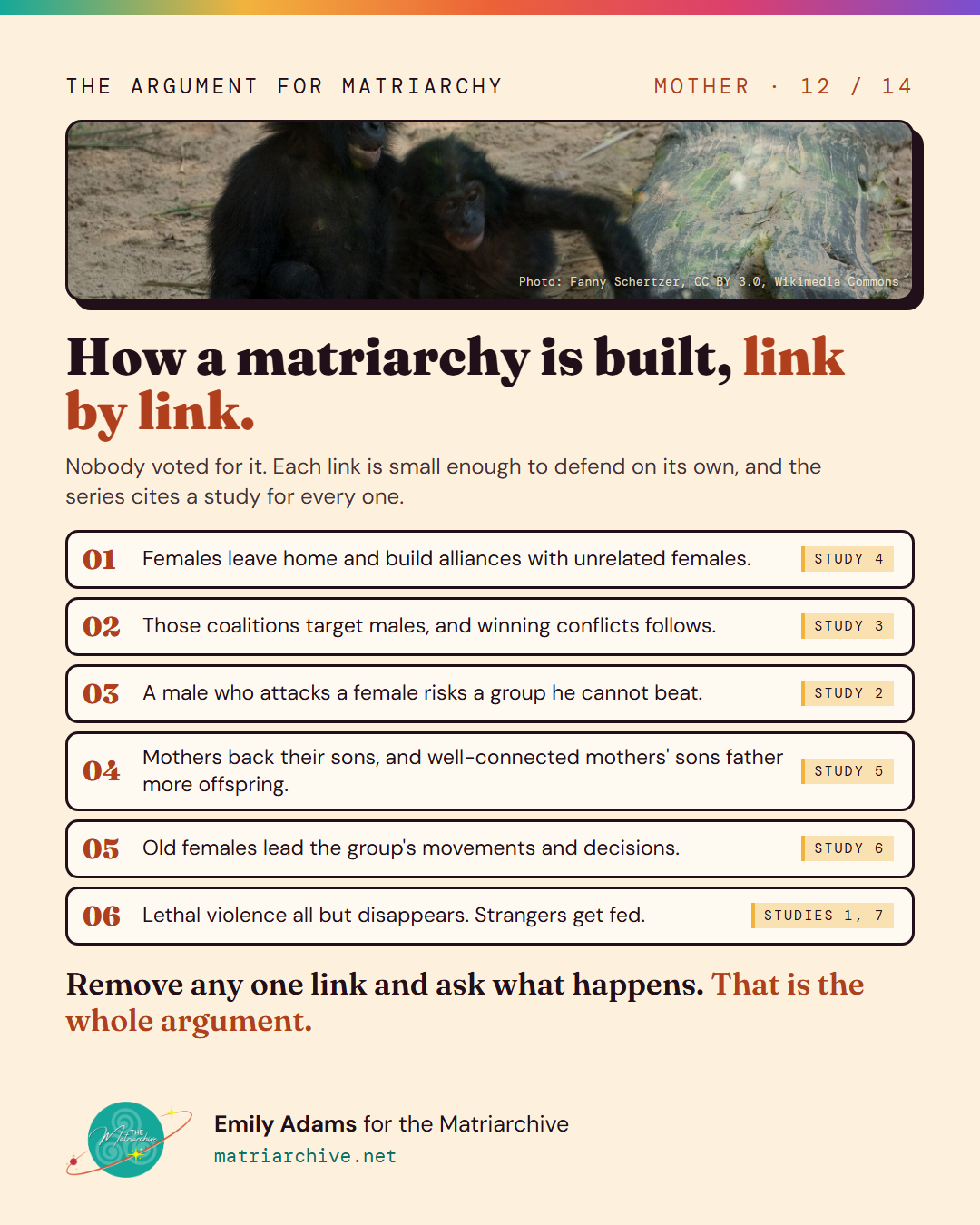
03 Chimpanzee communities: 152 killings. Bonobo communities: one suspected. Same genus, same forests, same food.
- “Male violence is not the price of being a primate. One of our two closest relatives mostly does without it.”
- “Chimpanzees did not stop killing when humans left them alone. The killing tracked their own social structure.”
- “When someone says it is just nature, ask which nature. Nature produced both of these.”
04 Male bonobos are not gentle. They are outnumbered. They start more fights than chimpanzee males. They just cannot win the ones that matter.
- “Nobody eradicated anything. Female coalitions made the worst kind of male aggression a losing move.”
- “A bonobo male who attacks a female risks a group he cannot beat. That is a deterrent, not a personality.”
- “Peace is not the absence of aggression. It is aggression that no longer pays.”
05 Female power came from coalitions, not size. Across six wild communities, males backed down in 61% of conflicts with females, and 85% of female coalitions targeted males. Where females teamed up more, they won more.
- “She did not have to be bigger than him. She had to be certain the others would come.”
- “Solidarity among the less powerful is a technology. It rewrites who wins.”
- “The question is never whether women are strong enough. It is whether we show up for each other in public.”
06 They were not sisters. They were strangers who chose each other. Female bonobos leave their birth group as adolescents and build their alliances from scratch.
- “Blood did not build this. Grooming did. Showing up did. Years of small loyalty did.”
- “The older females backed the younger ones against males. That is what a senior woman is for.”
- “You will arrive somewhere as a stranger. Find the women. Then be the one who comes when called.”
07 The sons of powerful mothers win. A male bonobo with his mother in the group had roughly three times the odds of fathering offspring compared with a male without her. In chimpanzees, mothers made no difference.
- “In a matriarchy, a mother is not a caretaker. She is the political unit her son belongs to.”
- “The bonobo male who thrives is not the strongest. He is the one whose mother is well connected.”
- “Give mothers power and watch what kind of son gets rewarded.”
08 The old females decide where everyone goes. When a wild bonobo group moved, it was old females who led the departures, and the group followed.
- “Leadership here is not the loudest or the largest. It is the one the group has learned to follow.”
- “An old woman with a network is the most powerful thing in the forest.”
- “Ask who the group actually follows when it is time to move. That is who holds power.”
09 Power without domination shares with strangers. Bonobos gave food to an unfamiliar bonobo over a group mate, and whole communities cooperated across borders instead of raiding them.
- “Chimpanzees patrol borders. Bonobos groom across them. Same genus. Different politics.”
- “A society run by coalitions of females treated the stranger as a possible ally, not a threat.”
- “Xenophobia is not the default primate setting. It is one setting.”
10 Peace is a system, not a temperament. Female bonobos stay together, feed together, and back each other against males, and researchers argue that structure is what keeps male aggression low.
- “Do not ask bonobos to be nicer. Look at how they organized themselves so niceness paid.”
- “Where females are together, a male cannot isolate one of them. Isolation is the first tool of violence.”
- “Build the structure and the behavior follows. That is true in a forest and it is true in a workplace.”
11 In a human society where women hold the lineage and the house, the health gap reversed. In patrilineal Mosuo communities, women had more than double the chronic inflammation of men. In matrilineal ones, women had less than men.
- “Chronic stress shows up in the body. So does its absence.”
- “This is one human society, studied once. It is the only one of its kind on these cards, and it points the same way as the apes.”
- “Where women hold property and kin, women are healthier. That is a measurement, not an opinion.”
The argument for matriarchy
Not women ruling men. Women backing women, in public, every time it counts. That is the only form of matriarchy the research has ever observed in our closest relatives, and it was enough to change what an entire species' males could get away with.
Bonobo females are smaller. They lose alone. They almost never have to fight alone, so they almost never lose. Male violence did not vanish. It stopped paying.
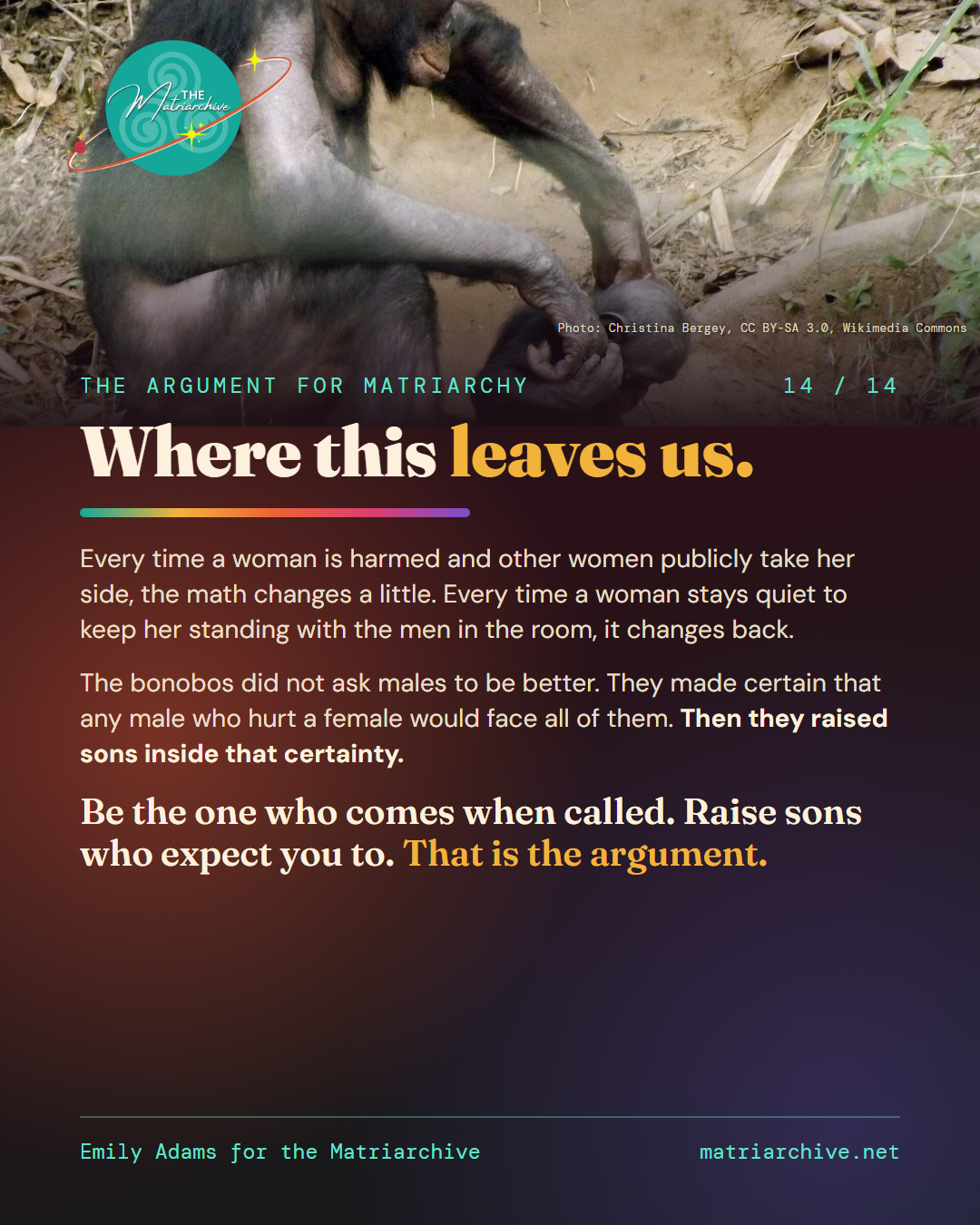
Every time a woman is harmed and other women publicly take her side, the math changes a little. Every time a woman stays quiet to keep her standing with the men in the room, it changes back. The bonobos did not ask males to be better. They made certain that any male who hurt a female would face all of them. Then they raised sons inside that certainty.
Every claim leads to a source
The studies
Listed in the order the cards use them, with background sources at the end. A scope line follows every study. If a finding could not be stated honestly in one scope line, it did not get a card. Verified against the Crossref registry, PubMed, and PubMed Central on October 2, 2026.
On cards 3 and 12 · Reference 1
Lethal Aggression in Pan Is Better Explained by Adaptive Strategies Than Human Impacts
Wilson et al., 2014 · Nature, 513(7518), 2014
The dataset holds 152 chimpanzee killings (58 observed, 41 inferred, 53 suspected) in 15 of the 18 chimpanzee communities studied, against a single suspected killing by bonobos. Among chimpanzees, males were 92 percent of attackers and 73 percent of victims, two thirds of killings were attacks on other communities, and attackers outnumbered victims by a median of eight to one. Killing rates did not track how disturbed a site was by humans, which is the paper's main point: chimpanzee killing looks like a strategy, not a symptom. The series uses this as the baseline. Same genus, same forests, one species kills and the other almost never does.
https://doi.org/10.1038/nature13727
Abstract free on PubMed (PMID 25230664); full text paywalled
On cards 4 and 12 · Reference 2
Differences in Expression of Male Aggression Between Wild Bonobos and Chimpanzees
Mouginot, Wilson, Desai and Surbeck, 2024 · Current Biology, 34(8), 1780 to 1785, 2024
This is the study that corrects the viral version of the bonobo story, and it is on the card for that reason. Aggression involving the focal males was 2.8 times more frequent in bonobos than in chimpanzees, and 3 times more frequent for contact aggression. What differed was the kind. Coalitionary aggression was 1 percent of bonobo acts (2 of 192) against 13 percent of chimpanzee acts (54 of 407), and chimpanzee males directed far more of their aggression at females. More aggressive males had more mating success in chimpanzees, and in bonobos only when the measure was restricted to contact aggression. The authors note that bonobo aggression is rarely injurious while chimpanzee coalitionary attacks often are. Nobody eradicated anything. The dangerous kind stopped paying.
https://doi.org/10.1016/j.cub.2024.02.071
Free author manuscript in PMC (PMC11167569)
On cards 5 and 12 · Reference 3
Drivers of Female Power in Bonobos
Surbeck et al., 2025 · Communications Biology, 8, 550, 2025
The first test across populations of what field researchers had argued for decades. Males submitted to females in 61 percent of intersexual conflicts on average, with a range from 18 to 100 percent across community-years, and the average female outranked 70 percent of the males in her community. Of the three explanations tested (winner-loser effects, mate competition, and female coalitions), female coalition formation was the one that predicted female power. Eighty-five percent of female coalitions targeted males. This is the spine of the series: female bonobos are smaller, and they hold power anyway, in proportion to how often they act together.
https://doi.org/10.1038/s42003-025-07900-8
Open access (CC BY; PMC12022330)
On cards 6 and 12 · Reference 4
Do Friends Help Each Other? Patterns of Female Coalition Formation in Wild Bonobos at Wamba
Tokuyama and Furuichi, 2016 · Animal Behaviour, 119, 27 to 35, 2016
Observers recorded 699 aggressive interactions and 108 coalitions. Of the 73 coalitions that included two or more females, every one targeted a male, usually after he had been aggressive toward a female, and females never formed coalitions against other females. In one-on-one conflicts between the sexes, females won 69 percent, and old females won 84 percent. Support ran one way, from older females to younger ones, and the females involved were mostly unrelated, because female bonobos leave their birth group at adolescence. The alliances that hold power in this community were built between strangers.
On cards 7 and 12 · Reference 5
Males with a Mother Living in Their Group Have Higher Paternity Success in Bonobos but Not Chimpanzees; Mothers Matter! Maternal Support, Dominance Status and Mating Success in Male Bonobos
Surbeck et al., 2019; Surbeck, Mundry and Hohmann, 2011 · Current Biology, 29(10), R354 to R355, 2019; Proceedings of the Royal Society B, 278(1705), 590 to 598, 2011
A bonobo male whose mother was living in the group at the time of conception was about three times as likely to be the father (odds ratio 3.14); in chimpanzees, a mother's presence made no difference, and the species difference was statistically significant. The sire's mother was present in 80 percent of bonobo paternities against 35 percent in chimpanzees. The 2011 study shows the mechanism in one community: mothers associated closely with their sons, intervened for them in conflicts with other males, and gave no such support to unrelated males. In a society where females hold power, the mother is the political unit her son belongs to.
https://doi.org/10.1016/j.cub.2019.03.040
2019: free author manuscript in PMC (PMC7335732). 2011: free full text in PMC (PMC3025686), https://doi.org/10.1098/rspb.2010.1572
On cards 8 and 12 · Reference 6
Leadership of Old Females in Collective Departures in Wild Bonobos (Pan paniscus) at Wamba
Tokuyama and Furuichi, 2017 · Behavioral Ecology and Sociobiology, 71(3), article 55, 2017
Who initiated a group move depended on age (more so for females), on centrality in the grooming network, and on male rank, and the three oldest females initiated more often than chance. The authors suggest old females are followed because they give coalitionary support to younger females and because they know the ranging area. Leadership here is not enforced. It is granted to the individual the group has learned to follow.
On cards 9 and 12 · Reference 7
Bonobos Share with Strangers; Cooperation Across Social Borders in Bonobos
Tan and Hare, 2013; Samuni and Surbeck, 2023 · PLoS ONE, 8(1), e51922, 2013; Science, 382(6672), 805 to 809, 2023
In the sanctuary experiments, 12 of 14 bonobos shared food at least once, and when given the choice they preferred to release a stranger over a groupmate; they also helped strangers reach food when no interaction was possible. In the wild study, individuals who cooperated more within their own group also cooperated more with members of the neighboring group, and preferentially with out-group members who were themselves strong cooperators, through grooming, coalitions, and food sharing. Chimpanzees patrol the border that these two bonobo communities groomed across.
https://doi.org/10.1371/journal.pone.0051922
2013: open access (CC BY; PMC3534679). 2023: paywalled at Science, https://doi.org/10.1126/science.adg0844; a repository copy is listed at Goettingen
On card 10 · Reference 8
Female Contributions to the Peaceful Nature of Bonobo Society; The Self-Domestication Hypothesis: Evolution of Bonobo Psychology Is Due to Selection Against Aggression
Furuichi, 2011; Hare, Wobber and Wrangham, 2012 · Evolutionary Anthropology, 20(4), 131 to 142, 2011; Animal Behaviour, 83(3), 573 to 585, 2012
Furuichi's review lays out the structural explanation the series relies on: female bonobos stay together and feed together, which means a male cannot isolate one of them; prolonged sexual receptivity lowers the payoff of competing for any one female; and females back each other against males. Hare, Wobber, and Wrangham propose that bonobos evolved under selection against aggression, leaving them with juvenile-like social tolerance into adulthood. Read together, they say peace is a system. The 2024 Mouginot study is a reminder that the system reduced the dangerous kind of aggression rather than aggression itself.
https://doi.org/10.1002/evan.20308
Both paywalled. 2012: https://doi.org/10.1016/j.anbehav.2011.12.007
On card 11 · Reference 9
Matriliny Reverses Gender Disparities in Inflammation and Hypertension Among the Mosuo of China
Reynolds et al., 2020 · PNAS, 117(48), 30324 to 30327, 2020
The only human study on the cards, and the one that keeps the series from being only about apes. In patrilineal communities, women had more than double the chronic inflammation of men (8.4 against 3.2 percent) and more hypertension (37.4 against 29.7 percent). In matrilineal communities, where women hold property and kin, both gaps reversed (inflammation 3.6 percent in women against 6.5 in men; hypertension 31.2 against 35.2). The authors attribute the reversal to women's autonomy and social support in the matrilineal communities. Chronic stress shows up in the body. So does its absence.
https://doi.org/10.1073/pnas.2014403117
Free full text in PMC (PMC7720212). A correction was published in 2021 (PNAS 118(37), e2112699118)
On card 2 · Reference 10
Female Power in Primates and the Phenomenon of Female Dominance
Lewis, 2018 · Annual Review of Anthropology, 47, 533 to 551, 2018
Lewis argues that 'female dominance' has been applied loosely to very different arrangements across primates and offers a consistent vocabulary. Power is the ability to elicit behavior from others. Dominance is power that rests on superior fighting ability. Leverage is power that rests on holding something the other party wants and cannot take by force. Female bonobos do not out-fight males one on one; their power is coalitional, which is why the series says a matriarchy is not a patriarchy with the sexes swapped.
https://doi.org/10.1146/annurev-anthro-102317-045958
Paywalled
Background · Reference 11
Intersexual Dominance Relationships and the Influence of Leverage on the Outcome of Conflicts in Wild Bonobos (Pan paniscus)
Surbeck and Hohmann, 2013 · Behavioral Ecology and Sociobiology, 67(11), 1767 to 1780, 2013
Tests how conflicts between the sexes are decided in one community, including whether a female's reproductive state gives her leverage. Background context for card 2.
Background · Reference 12
Female Relationships in Bonobos (Pan paniscus): Evidence for Bonding, Cooperation, and Female Dominance in a Male-Philopatric Species
Parish, 1996 · Human Nature, 7(1), 61 to 96, 1996
One of the first papers to argue, from captive groups, that unrelated female bonobos bond, cooperate, and dominate males. The field work that followed is what the cards cite.
https://doi.org/10.1007/BF02733490
Paywalled
Background · Reference 13
Agonistic Interactions and Matrifocal Dominance Rank of Wild Bonobos (Pan paniscus) at Wamba
Furuichi, 1997 · International Journal of Primatology, 18(6), 855 to 875, 1997
Early field evidence that male rank at Wamba tracked the rank of the male's mother. The 2011 and 2019 studies on card 7 are the modern versions of this finding.
Background · Reference 14
Sex-Specific Association Patterns in Bonobos and Chimpanzees Reflect Species Differences in Cooperation
Surbeck et al., 2017 · Royal Society Open Science, 4(5), 161081, 2017
Female bonobos associate with each other more than female chimpanzees do, and the sexes mix more in bonobos. Who is physically together is the precondition for who can form a coalition. Background for card 10.
https://doi.org/10.1098/rsos.161081
Open access (PMC5451801)
Background · Reference 15
Inter-Group Aggressive Interaction Patterns Indicate Male Mate Defense and Female Cooperation Across Bonobo Groups at Wamba, Democratic Republic of the Congo
Tokuyama, Sakamaki and Furuichi, 2019 · American Journal of Physical Anthropology, 170(4), 535 to 550, 2019
When bonobo groups met, males were aggressive mostly in defense of mates, while females from different groups cooperated with each other. Background for card 9.
https://doi.org/10.1002/ajpa.23929
Paywalled
Background · Reference 16
Food Sharing Across Borders: First Observation of Intercommunity Meat Sharing by Bonobos at LuiKotale, DRC
Fruth and Hohmann, 2018 · Human Nature, 29(2), 91 to 103, 2018
The first recorded case of bonobos from one community sharing meat with members of another. One event, cited only as a sign of what the 2023 study later measured.
https://doi.org/10.1007/s12110-018-9311-9
Open access (CC BY; PMC5942352)
Background · Reference 17
Intra- and Inter-Sexual Aggression by Bonobos in the Context of Mating
Hohmann and Fruth, 2003 · Behaviour, 140(11 to 12), 1389 to 1413, 2003
Documents aggression around mating in wild bonobos, including by females. The series never claims bonobos are without aggression, and this is one of the papers that keeps that honest.
Background · Reference 18
Mate Competition, Testosterone and Intersexual Relationships in Bonobos, Pan paniscus
Surbeck, Deschner, Schubert, Weltring and Hohmann, 2012 · Animal Behaviour, 83(3), 659 to 669, 2012
Male bonobos compete for mates, and their hormones respond to it, yet the competition rarely turns into the coalitionary violence seen in chimpanzees. Background for card 4.
Background · Reference 19
The 'Tolerant Chimpanzee': Towards the Costs and Benefits of Sociality in Female Bonobos
Nurmi, Hohmann, Goldstone, Deschner and Schuelke, 2018 · Behavioral Ecology, 29(6), 1325 to 1339, 2018
Being together is not free: female bonobos pay feeding competition costs for their sociality. The coalitions on these cards are maintained at a price, which is part of why they are impressive.
Background · Reference 20
Sex Differences in the Steepness of Dominance Hierarchies in Captive Bonobo Groups
Stevens, Vervaecke, de Vries and van Elsacker, 2007 · International Journal of Primatology, 28(6), 1417 to 1430, 2007
In captive groups, male hierarchies were steeper than female ones. Background for card 2.
Background · Reference 21
Dominance and Its Behavioral Measures in a Captive Group of Bonobos (Pan paniscus)
Vervaecke, de Vries and van Elsacker, 2000 · International Journal of Primatology, 21(1), 47 to 68, 2000
Methods paper on how to measure dominance in bonobos. Background only.
Background · Reference 22
Bonobos Exhibit Delayed Development of Social Behavior and Cognition Relative to Chimpanzees
Wobber, Wrangham and Hare, 2010 · Current Biology, 20(3), 226 to 230, 2010
Bonobos develop some social behaviors later than chimpanzees and keep juvenile-like tolerance longer. Background for card 10.
The photographs
Every image is a real bonobo, from Wikimedia Commons, under an open license. Cropped and toned to sit inside the series, otherwise unaltered. Click a title for the original file and its license.
- 6 bonobos WHCalvin IMG 1341.jpg · W. H. Calvin · CC BY-SA 4.0
- Lola ya bonobo (7).jpg · Fanny Schertzer · CC BY 3.0
- Bonobo male Jasongo 15yo Twycross 582a (2014 11 14 01 04 18 UTC).jpg · William H. Calvin · CC BY-SA 4.0
- Lola ya bonobo (10).jpg · Fanny Schertzer · CC BY 3.0
- Bonobo group hug.jpg · LaggedOnUser · CC BY-SA 2.0
- Ida une jeune qui devra quitter son groupe à l'adolescence.jpg · DBeaune · CC BY-SA 4.0
- Ulrik, jeune de 1 ans avec sa mère Uma. LuiKotale, RDC.jpg · DBeaune · CC BY-SA 4.0
- Pan paniscus (female, walking).jpg · Hans Hillewaert · CC BY-SA 3.0
- Grooming de Zoé.jpg · DBeaune · CC BY-SA 4.0
- Lola ya bonobo (20).jpg · Fanny Schertzer · CC BY 3.0
- Pan paniscus (Bonobo baby and mother).jpg · Nhobgood Nick Hobgood · CC BY-SA 3.0
- Lola ya bonobo (3).jpg · Fanny Schertzer · CC BY 3.0
- Bonobo (Pan paniscus) at Lola Ya Bonobo - 3.JPG · Christina Bergey · CC BY-SA 3.0
- Lola ya bonobo (9).jpg · Fanny Schertzer · CC BY 3.0
This series also lives, in Emily Adams Creative branding, at emilyadams.net/argument-for-matriarchy.